The Pilgrim's Progress · Part Two · Scene 32 of 35
Gaius' Inn
GREAT-HEART. Why, what would, or could you have done, to have helped yourself, if we indeed had been of that company. HON. Done! why I would have fought as long as breath had been in me; and had I so done, I am sure you could never have given me the worst on it; for a Christian can never be overcome, unless he should yield of himself.
GREAT-HEART. Well said, father Honest, quoth the guide; for by this I know thou art a cock of the right kind, for thou hast said the truth.
HON. And by this, also, I know that thou knowest what true pilgrimage is; for all others do think that we are the soonest overcome of any.
GREAT-HEART. Well, now we are so happily met, pray let me crave your name, and the name of the place you came from.
HON. My name I cannot; but I came from the town of Stupidity; it lieth about four degrees beyond the City of Destruction.
GREAT-HEART. Oh! are you that countryman, then? I deem I have half a guess of you; your name is Old Honesty, is it not? So the old gentleman blushed, and said, Not Honesty, in the abstract, but Honest is my name; and I wish that my nature shall agree to what I am called.
HON. But, Sir, said the old gentleman, how could you guess that I am such a man, since I came from such a place?
GREAT-HEART. I had heard of you before, by my Master; for He knows all things that are done on the earth; but I have often wondered that any should come from your place, for your town is worse than is the City of Destruction itself.
HON. Yes, we lie more off from the sun, and so are more cold and senseless; but was a man in a mountain of ice, yet if the Sun of Righteousness will arise upon him, his frozen heart shall feel a thaw; and thus it hath been with me.
GREAT-HEART. I believe it, father Honest, I believe it; for I know the thing is true.
Then the old gentleman saluted all the Pilgrims with a holy kiss of charity; and asked them of their names, and how they had fared since they set out on their pilgrimage.
CHRIST. Then said Christiana, My name, I suppose you have heard of; good Christian was my husband, and these four were his children. But can you think how the old gentleman was taken, when she told him who she was! He skipped, he smiled, and blessed them with a thousand good wishes, saying:
HON. I have heard much of your husband, and of his travels and wars, which he underwent in his days. Be it spoken to your comfort, the name of your husband rings over all these parts of the world: his faith, his courage, his enduring, and his sincerity under all, has made his name famous. Then he turned him to the boys, and asked them of their names, which they told him. And then said he unto them: Matthew, be thou like Matthew the publican, not in vice, but in virtue (Matt. 10:3). Samuel, said he, be thou like Samuel the Prophet, a man of faith and prayer (Psa. 99:6). Joseph, said he, be thou like Joseph in Potiphar's house, chaste, and one that flees from temptation (Gen. 39). And James, be thou like James the Just, and like James the brother of our Lord (Acts 1:13, 14). Then they told him of Mercy, and how she had left her town and her kindred to come along with Christiana and with her sons. At that the old honest man said, Mercy is thy name; by Mercy shalt thou be sustained, and carried through all those difficulties that shall assault thee in thy way, till thou shalt come thither, where thou shalt look the Fountain of Mercy in the face with comfort. All this while the guide, Mr. Great-heart, was very much pleased, and smiled upon his companion.
Now, as they walked along together, the guide asked the old gentleman, if he did not know one Mr. Fearing, that came on pilgrimage out of his parts?
HON. Yes, very well, said he. He was a man that had the root of the matter in him; but he was one of the most troublesome pilgrims that ever I met with in all my days.
GREAT-HEART. I perceive you knew him; for you have given a very right character of him.
HON. Knew him! I was a great companion of his; I was with him most an end; when he first began to think of what would come upon us hereafter, I was with him.
GREAT-HEART. I was his guide from my Master's house to the gates of the Celestial City.
HON. Then you knew him to be a troublesome one.
GREAT-HEART. I did so, but I could very well bear it; for men of my calling are oftentimes intrusted with the conduct of such as he was.
HON. Well then, pray let us hear a little of him, and how he managed himself under your conduct.
GREAT-HEART. Why, he was always afraid that he should come short of whither he had a desire to go. Everything frightened him that he heard anybody speak of, that had but the least appearance of opposition in it. I hear that he lay roaring at the Slough of Despond for about a month together; nor durst he, for all he saw several go over before him, venture, though they, many of them, offered to lend him their hand. He would not go back again neither. The Celestial City, he said, he should die if he came not to it; and yet was dejected at every difficulty, and stumbled at every straw that anybody cast in his way. Well, after he had lain at the Slough of Despond a great while, as I have told you, one sunshine morning, I do not know how, he ventured, and so got over; but when he was over, he would scarce believe it. He had, I think, a Slough of Despond in his mind; a slough that he carried everywhere with him, or else he could never have been as he was. So he came up to the gate, you know what I mean, that stands at the head of this way; and there also he stood a good while, before he would adventure to knock. When the gate was opened, he would give back, and give place to others, and say that he was not worthy. For, for all he got before some to the gate, yet many of them went in before him. There the poor man would stand, shaking and shrinking. I dare say, it would have pitied one's heart to have seen him; nor would he go back again. At last, he took the hammer that hanged on the gate in his hand, and gave a small rap or two; then One opened to him, but he shrank back as before. He that opened stepped out after him, and said, Thou trembling one, what wantest thou? With that he fell down to the ground. He that spoke to him wondered to see him so faint. So he said to him, Peace be to thee; up, for I have set open the door to thee. Come in, for thou art blessed. With that he got up, and went in trembling; and when he was in, he was ashamed to show his face. Well, after he had been entertained there a while, as you know how the manner is, he was bid go on his way, and also told the way he should take. So he came till he came to our house. But as he behaved himself at the gate, so he did His behaviour at my Master the Interpreter's door. He lay thereabout in the cold a good while, before he would adventure to call; yet he would not go back, and the nights were long and cold then. Nay, he had a note of necessity in his bosom to my Master, to receive him and grant him the comfort of His house, and also to allow him a stout and valiant conductor, because he was himself so chicken-hearted a man; and yet, for all that, he was afraid to call at the door. So he lay up and down thereabouts, till, poor man! he was almost starved. Yea, so great was his dejection, that though he saw several others, for knocking, get in, yet he was afraid to venture. At last, I think, I looked out of the window, and perceiving a man to be up and down about the door, I went out to him, and asked what he was; but, poor man! the water stood in his eyes; so I perceived what he wanted. I went, therefore, in and told it in the house, and we showed the thing to our Lord. So He sent me out again, to entreat him to come in; but, I dare say, I had hard work to do it. At last he came in; and I will say that for my Lord, He carried it wonderfully lovingly to him. There were but a few good bits at the table, but some of it was laid upon his trencher. Then he presented the note, and my Lord looked thereon, and said his desire should he granted. So, when he had been there a good while, he seemed to get some heart, and to be a little more comfortable; for my Master, you must know, is one of very tender bowels, especially to them that are afraid; wherefore He carried it so towards him, as might tend most to his encouragement. Well, when he had had a sight of the things of the place, and was ready to take his journey to go to the city, my Lord, as He did to Christian before, gave him a bottle of spirits, and some comfortable things to eat. Thus we set forward, and I went before him; but the man was but of few words, only he would sigh aloud.
When we were come to where the three fellows were hanged, he said that he doubted that that would be his end also. Only he seemed glad when he saw the Cross and the Sepulchre. There, I confess, he desired to stay a little to look, and he seemed, for a while after, to be a little cheery. When we came at the Hill Difficulty, he made no stick at that, nor did he much fear the lions; for you must know that his trouble was not about such things as those; his fear was about his acceptance at last.
I got him in at the House Beautiful, I think, before he was willing. Also, when he was in, I brought him acquainted with the damsels that were of the place; but he was ashamed to make himself much for company. He desired much to be alone, yet he always loved good talk, and often would get behind the screen to hear it. He also loved much to see ancient things, and to be pondering them in his mind. He told me afterwards that he loved to be in those two houses from which he came last, to wit, at the gate, and that of the Interpreter, but that he durst not be so bold to ask.
When we went also from the House Beautiful, he went down the hill, into the Valley of Humiliation, he went down as well as ever I saw man in my life; for he cared not how mean he was, so he might he happy at last. Yea, I think, there was a kind of a sympathy betwixt that valley and him; for I never saw him better in all his pilgrimage than when he was in that valley.
Here he would lie down, embrace the ground, and kiss the very flowers that grew in this valley (Lam. 3:27-29). He would now be up every morning by break of day, tracing and walking to and fro in this valley.
But when he was come to the entrance of the Valley of the Shadow of Death, I thought I should have lost my man; not for that he had any inclination to go back; that he always abhorred; but he was ready to die for fear. Oh! the hobgoblins will have me! the hobgoblins will have me! cried he; and I could not beat him out on it. He made such a noise, and such an outcry here, that, had they but heard him, it was enough to encourage them to come and fall upon us.
But this I took very great notice of, that this valley was as quiet while he went through it, as ever I knew it before or since. I suppose these enemies here had now a special check from our Lord, and a command not to meddle until Mr. Fearing was passed over it.
It would he too tedious to tell you of all. We will, therefore, only mention a passage or two more. When he was come at Vanity Fair, I thought he would have fought with all at the men at the fair. I feared there we should both have been knocked on the head, so hot was he against their fooleries. Upon the Enchanted Ground, he was also very wakeful. But when he was come at the river, where was no bridge, there again he was in a heavy case. Now, now, he said, he should be drowned forever, and so never see that Face with comfort that he had come so many miles to behold.
And here, also, I took notice of what was very remarkable; the water of that river was lower at this time than ever I saw it in all my life. So he went over at last, not much above wet-shod. When he was going up to the gate, I began to take his leave of him, and to wish him a good reception above. So he said, I shall, I shall. Then parted we asunder, and I saw him no more.
HON. Then, it seems, he was well at last.
GREAT-HEART. Yes, yes; I never had doubt about him; he was a man of a choice spirit, only he was always kept very low, and that made his life so burdensome to himself, and so troublesome to others (Psa. 88). He was, above many, tender of sin. He was so afraid of doing injuries to others, that he often would deny himself of that which was lawful, because he would not offend (Rom. 14:21; 1 Cor. 8:13).
HON. But what should be the reason that such a good man should be all his days so much in the dark?
GREAT-HEART. There are two sorts of reasons for it: One is, the wise God will have it so; some must pipe, and some must weep (Matt. 11:16-18). Now Mr. Fearing was one that played upon this bass; he and his fellows sound the sackbut, whose notes are more doleful than the notes of other music are; though, indeed, some say the bass is the ground of music. And, for my part, I care not at all for that profession that begins not in heaviness of mind. The first string that the musician usually touches is the bass, when he intends to put all in tune. God also plays upon this string first, when he sets the soul in tune for Himself. Only here was the imperfection of Mr. Fearing, he could play upon no other music but this, till towards his latter end.
I make bold to talk thus metaphorically, for the ripening of the wits of young readers; and because, in the book of the Revelations, the saved are compared to a company of musicians that play upon their trumpets and harps, and sing their songs before the throne (Rev. 8:2; 14:2, 3).
HON. He was a very zealous man, as one may see by what relation you have given of him; difficulties, lions, or Vanity Fair, he feared not at all. It was only sin, death, and hell that was to him a terror, because he had some doubts about his interest in that celestial country.
GREAT-HEART. You say right. Those were the things that were his troublers, and they, as you have well observed, arose from the weakness of his mind thereabout, not from weakness of spirit as to the practical part of a pilgrim's life. I dare believe that, as the proverb is, 'he could have bit a firebrand, had it stood in his way'; but the things with which he was oppressed, no man ever yet could shake off with ease.
CHRIST. Then said Christiana, This relation of Mr. Fearing has done me good. I thought nobody had been like me; but I see there was some semblance betwixt this good man and I; only we differed in two things: His troubles were so great, they break out; but mine I kept within. His, also, lay so hard upon him, they made him that he could not knock at the houses provided for entertainment; but my trouble was always such as made me knock the louder.
MERCY. If I might also speak my heart, I must say, that something of him has also dwelt in me; for I have ever been more afraid of the lake, and the loss of a place in Paradise, than I have been of the loss of other things. O, thought I, may I have the happiness to have a habitation there, it is enough, though I part with all the world to win it!
MATT. Then said Matthew, Fear was one thing that made me think that I was far from having that within me that accompanies salvation; but if it were so with such a good man as he, why may it not also go well with me?
JAMES. No fears, no grace, said James. Though there is not always grace where thereis the fear of hell, yet, to be sure, there is no grace where there is no fear of God.
GREAT-HEART. Well said, James, thou hast hit the mark; for the fear of God is the beginning of wisdom; and, to be sure, they that lack the beginning, have neither middle nor end. But we will here conclude our discourse of Mr. Fearing, after we have sent after him this farewell.
Well, Master Fearing, thou didst fear Thy God, and wast afraid Of doing anything, while here, That would have thee betray'd. And didst thou fear the lake and pit? Would others did so too! For, as for them that want thy wit, They do themselves undo.
Now I saw, that they still went on in their talk; for after Mr. Great-heart had made an end with Mr. Fearing, Mr. Honest began to tell them of another, but his name was Mr. Self-will. He pretended himself to be a pilgrim, said Mr. Honest; but I persuade myself he never came in at the gate that stands at the head of the way.
GREAT-HEART. Had you ever any talk with him about it?
HON. Yes, more than once or twice; but he would always be like himself, self-willed. He neither cared for man, nor argument, nor yet example; what his mind prompted him to, that he would do, and nothing else could he be got to.
GREAT-HEART. Pray, what principles did he hold? for I suppose you can tell.
HON. He held, that a man might follow the vices as well as the virtues of the pilgrims; and that if he did both, he should be certainly saved.
GREAT-HEART. How! if he had said, It is possible for the heart to be guilty of the vices, as well as to partake of the virtues of pilgrims, he could not much have been blamed; for indeed we are exempted from no vice absolutely, but on condition that we watch and strive. But this, I perceive, is not the thing; but if I understand you right, your meaning is, that he was of that opinion, that it was allowable so to be.
HON. Aye, aye, so I mean; and so he believed and practised.
GREAT-HEART. But what ground had he for his so saying?
HON. Why, he said he had the Scripture for his warrant.
GREAT-HEART. Prithee, Mr. Honest, present us with a few particulars.
HON. So I will. He said, To have to do with other men's wives, had been practised by David, God's beloved; and therefore he could do it. He said, To have more women than one, was a thing that Solomon practised; and therefore he could do it. He said, That Sarah and the godly midwives of Egypt lied, and so did saved Rahab; and therefore he could do it. He said, That the disciples went at the bidding of their Master, and took away the owner's ass; and therefore he could do so too. He said, That Jacob got the inheritance of his father in a way of guile and dissimulation; and therefore he could do so too.
GREAT-HEART. Highly base! indeed. And you are sure he was of this opinion?
HON. I have heard him plead for it, bring Scripture for it, bring argument for it, &c.
GREAT-HEART. An opinion that is not fit to be with any allowance in the world.
HON. You must understand me rightly. He did not say that any man might do this; but that those that had the virtues of those that did such things, might also do the same.
GREAT-HEART. But what more false than such a conclusion? for this is as much as to say, that because good men heretofore have sinned of infirmity, therefore he had allowance to do it of a presumptuous mind; or if, because a child by the blast of the wind, or for that it stumbled at a stone, fell down, and defiled itself in mire, therefore he might willfully lie down and wallow like a boar therein. Who could have thought that anyone could so far have been blinded by the power of lust? But what is written must be true: They 'stumble at the Word, being disobedient; whereunto also they were appointed' (1 Peter 2:8).
His supposing that such may have the godly men's virtues, who addict themselves to their vices, is also a delusion as strong as the other. It is just as if the dog should say, I have, or may have, the qualities of the child, because I lick up its stinking excrements. To eat up the sin of God's people, is no sign of one that is possessed with their virtues (Hosea 4:8). Nor can I believe, that one that is of this opinion, can at present have faith or love in him. But I know you have made strong objections against him; prithee, what can he say for himself?
HON. Why, he says, To do this by way of opinion, seems abundance more honest, than to do it, and yet hold contrary to it in opinion.
GREAT-HEART. A very wicked answer; for though to let loose the bridle to lusts, while our opinions are against such things, is bad; yet, to sin, and plead a toleration so to do, is worse. The one stumbles beholders accidentally, the other pleads them into the snare.
HON. There are many of this man's mind, that have not this man's mouth; and that makes going on pilgrimage of so little esteem as it is.
GREAT-HEART. You have said the truth, and it is to be lamented; but he that feareth the King of Paradise, shall come out of them all.
CHRIST. There are strange opinions in the world; I know one that said, It was time enough to repent when they come to die.
GREAT-HEART. Such are not over wise. That man would have been loath, might he have had a week to run twenty miles in for his life, to have deferred that journey to the last hour of that week.
HON. You say right; and yet the generality of them, that count themselves pilgrims, do indeed do thus. I am, as you see, an old man, and have been a traveler in this road many a day; and I have taken notice of many things.
I have seen some that have set out as if they would drive all the world afore them, who yet have, in few days, died as they in the wilderness, and so never got sight of the promised land. I have seen some that have promised nothing, at first setting out to be pilgrims, and that one would have thought could not have lived a day, that have yet proved very good pilgrims.
I have seen some who have run hastily forward, that again have, after a little time, run as fast just back again.
I have seen some who have spoken very well of a pilgrim's life at first, that, after a while, have spoken as much against it. I have heard some, when they first set out for Paradise, say positively there is such a place; who when they have been almost there, have come back again, and said there is none.
I have heard some vaunt what they would do, in case they should he opposed, that have, even at a false alarm, fled faith, the pilgrim's way, and all.
Now, as they were thus in their way, there came one running to meet them, and said, Gentlemen, and you of the weaker sort, if you love life, shift for yourselves, for the robbers are before you.
GREAT-HEART. Then said Mr. Great-heart, They be the three that set upon Little-faith heretofore. Well, said he, we are ready for them; so they went on their way. Now, they looked at every turning, when they should have met with the villains; but whether they heard of Mr. Great-heart, or whether they had some other game, they came not up to the Pilgrims.
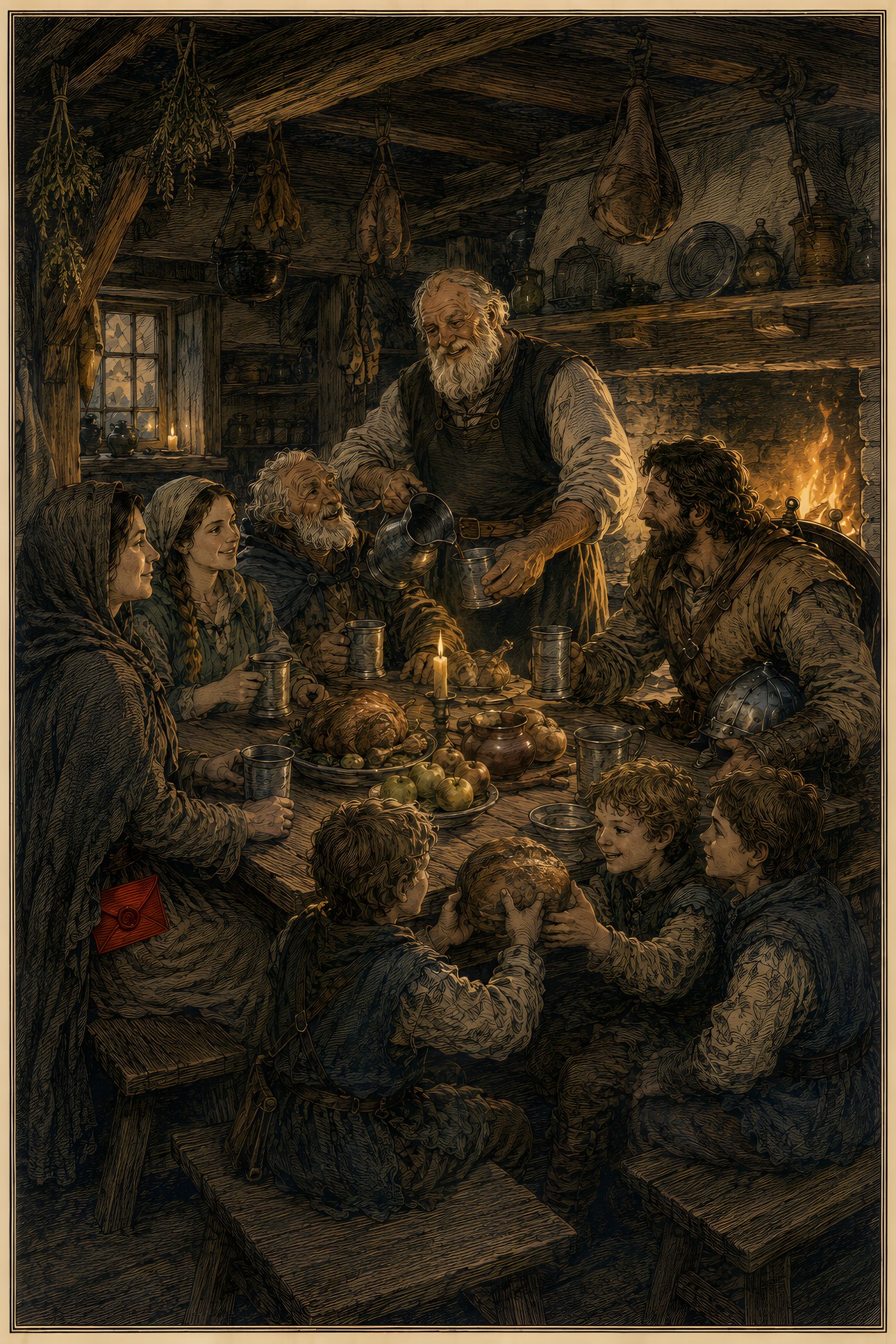
Christiana then wished for an inn for herself and her children, because they were weary. Then said Mr. Honest, There is one a little before us, where a very honourable disciple, one Gaius, dwells (Rom. 16:23). So they all concluded to turn in thither, and the rather, because the old gentleman gave him so good a report. So when they came to the door, they went in, not knocking, for folks use not to knock at the door of an inn. Then they called for the master of the house, and he came to them. So they asked if they might lie there that night.