The Pilgrim's Progress · Part Two · Scene 23 of 35
Christiana's Summons
The Author's Way of Sending Forth his Second Part of the Pilgrim
Go now, my little book, to every place, Where my first Pilgrim has but shown his face, Call at their door. If any say, Who's there? Then answer thou, CHRISTIANA is here. If they bid thee come in, then enter thou, With all thy boys; and then, as thou know'st how, Tell who they are, also from whence they came; Perhaps they know them by their looks, or name. But if they should not, ask them yet again If formerly they did not entertain One CHRISTIAN, a Pilgrim? If they say They did; and were delighted in his way: Then let them know, that those related were Unto him; yea, his wife and children are.
Tell them, that they have left their house and home, Are turned Pilgrims, seek a world to come; That they have met with hardships in the way, That they do meet with troubles night and day; That they have trod on serpents, fought with devils, Have also overcome a many evils. Yea, tell them also of the next, who have Of love to pilgrimage, been stout and brave Defenders of that way, and how they still Refuse this world, to do their Father's will.
Go, tell them also of those dainty things, That pilgrimage unto the Pilgrim brings. Let them acquainted be, too, how they are Beloved of their King, under His care: What goodly mansions for them He provides, Tho' they meet with rough winds, and swelling tides, How brave a calm they will enjoy at last, Who to their Lord, and by His ways hold fast.
Perhaps with heart and hand they will embrace Thee, as they did my firstling, and will grace Thee, and thy fellows, with such cheer and fare, As show will they of Pilgrims lovers are.
OBJECTION 1. But how, if they will not believe of me That I am truly thine; cause some there be That counterfeit the Pilgrim and his name, Seek, by disguise, to seem the very same; And by that means have wrought themselves into The hands and houses of I know not who?
ANSWER. 'Tis true, some have of late, to counterfeit My Pilgrim, to their own my title set; Yea others, half my name and title too Have stitched to their book, to make them do; But yet they, by their features, do declare Themselves not mine to be, whose e'er they are.
If such thou meet'st with, then thine only way Before them all, is, to say out thy say, In thine own native language, which no man Now useth, nor with ease dissemble can. If, after all, they still of you shall doubt, Thinking that you, like gipsies, go about
In naughty wise, the country to defile, Or that you seek good people to beguile With things unwarrantable; send for me, And I will testify you PILGRIMS be. Yea, I will testify that only you My Pilgrims are; and that alone will do.
OBJECTION 2 But yet, perhaps, I may inquire for him, Of those that wish him damned, life and limb. What shall I do, when I at such a door For Pilgrims ask, and they shall rage the more?
ANSWER. Fright not thyself, my book, for such bugbears Are nothing else but ground for groundless fears. My Pilgrim's book has travell'd sea and land, Yet could I never come to understand That it was slighted, or turn'd out of door By any kingdom, were they rich or poor.
In France and Flanders, where men kill each other, My Pilgrim is esteem'd a friend, a brother. In Holland too, 'tis said, as I am told, My Pilgrim is with some worth more than gold.
Highlanders and wild Irish can agree My Pilgrim should familiar with them be. 'Tis in New England under such advance, Receives there so much loving countenance, As to be trimm'd, new cloth'd, and deck'd with gems That it may show its features and its limbs, Yet more; so comely doth my Pilgrim walk, That of him thousands daily sing and talk.
If you draw nearer home, it will appear, My Pilgrim knows no ground of shame or fear; City and country will him entertain With, Welcome Pilgrim; yea, they can't refrain From smiling, if my Pilgrim be but by, Or shows his head in any company.
Brave gallants do my Pilgrim hug and love, Esteem it much, yea, value it above Things of a greater bulk: yea, with delight, Say, My lark's leg is better than a kite.
Young ladies, and young gentlewomen too, Do no small kindness to my Pilgrim show. Their cabinets, their bosoms, and their hearts, My Pilgrim has, 'cause he to them imparts His pretty riddles in such wholesome strains, As yields them profit double to their pains Of reading; yea, I think, I may be bold To say, some prize him far above their gold.
The very children that do walk the street, If they do but my holy Pilgrim meet, Salute him well, will wish him well, and say, He is the only stripling of the day.
They that have never seen him, yet admire What they have heard of him, and much desire To have his company, and hear him tell Those pilgrim stories which he knows so well.
Yea, some who did not love him at the first, But called him fool and noddy, say they must, Now they have seen and heard him, him commend And to those whom they love, they do him send.
Wherefore, my Second Part, thou need'st not be Afraid to show thy head; none can hurt thee, That wish but well to him that went before, 'Cause thou com'st after with a second store Of things as good, as rich, as profitable, For young, for old, for stagg'ring, and for stable.
OBJECTION 3. But some there he that say, He laughs too loud And some do say, His head is in a cloud. Some say, His words and stories are so dark, They know not how, by them, to find his mark.
ANSWER. One may, I think, say, Both his laughs and cries, May well be guess'd at by his wat'ry eyes. Some things are of that nature, as to make One's fancy chuckle, while his heart doth ache. When Jacob saw his Rachel with the sheep, He did at the same time both kiss and weep.
Whereas some say, A cloud is in his head, That doth but show how wisdom's covered With its own mantles, and to stir the mind To a search after what it fain would find. Things that seem to be hid in words obscure, Do but the godly mind the more allure To study what those sayings should contain, That speak to us in such a cloudy strain.
I also know a dark similitude Will on the fancy more itself intrude, And will stick faster in the heart and head, Than things from similes not borrowed. Wherefore, my book, let no discouragement Hinder thy travels. Behold, thou art sent To friends, not foes; to friends that will give place To thee, thy Pilgrims, and thy words embrace.
Besides, what my first Pilgrim left conceal'd Thou, my brave second Pilgrim, hast reveal'd; What CHRISTIAN left lock'd up, and went his way, Sweet CHRISTIANA opens with her key.
OBJECTION 4. But some love not the method of your first; Romance they count it, throw't away as dust, If I should meet with such, what should I say? Must I slight them as they slight me, or nay?
ANSWER. My CHRISTIANA, if with such thou meet, By all means, in all loving-wise, them greet; Render them not reviling for revile; But if they frown, I prithee on them smile; Perhaps 'tis nature, or some ill report, Has made them thus despise, or thus retort.
Some love no cheese, some love no fish, and some Love not their friends, nor their own house or home; Some start at pig, slight chicken, love not fowl, More than they love a cuckoo, or an owl; Leave such, my CHRISTIANA, to their choice, And seek those who to find thee will rejoice; By no means strive, but in humble-wise, Present thee to them in thy Pilgrim's guise.
Go, then, my little book, and show to all That entertain, and bid thee welcome shall, What thou shalt keep close, shut up from the rest, And wish what thou shalt show them may be blest To them for good, may make them choose to be Pilgrims better by far than thee or me.
Go, then, I say, tell all men who thou art; Say, I am CHRISTIANA, and my part Is now, with my four sons, to tell you what It is for men to take a Pilgrims lot.
Go also, tell them who and what they be, That now do go on pilgrimage with thee; Say, Here's my neighbour, Mercy, she is one That has long time with me a Pilgrim gone. Come, see her in her virgin race, and learn 'Twixt idle ones and Pilgrims to discern. Yea, let young damsels learn of her to prize The world which is to come, in any wise. When little tripping maidens follow God, And leave old doting sinners to His rod; 'Tis like those days wherein the young ones cried, Hosanna! to whom old ones did deride.
Next, tell them of old Honest, who you found With his white hairs, treading the Pilgrim's ground. Yea, tell them how plain-hearted this man was, How after his good Lord he bare his cross. Perhaps with some gray head this may prevail With Christ to fall in love, and sin bewail.
Tell them also, how Master Fearing went On pilgrimage, and how the time he spent In solitariness, with fears and cries; And how, at last, he won the joyful prize. He was a good man, though much down in spirit, He is a good man, and doth life inherit.
Tell them of Master Feeble-mind also, Who, not before, but still behind would go. Show them also, how he had like been slain, And how one Great-heart did his life regain. This man was true of heart, though weak in grace, One might true godliness read in his face.
Then tell them of Master Ready-to-halt, A man with crutches, but much without fault; Tell them how Master Feeble-mind and he Did love, and in opinions much agree. And let all know, though weakness was their chance, Yet sometimes one could sing, the other dance.
Forget not Master Valiant-for-the-truth, That man of courage, though a very youth. Tell everyone his spirit was so stout, No man could ever make him face about; And how Great-heart and he could not forbear, But put down Doubting Castle, slay Despair.
Overlook not Master Despondency, Nor Much-afraid, his daughter, though they lie Under such mantles, as may make them look (With some) as if their God had them forsook. They softly went, but sure, and at the end, Found that the Lord of Pilgrims was their friend. When thou hast told the world of all these things, Then turn about, my book, and touch these strings, Which, if but touch'd, will such music make, They'll make a cripple dance, a giant quake.
These riddles that lie couch'd within thy breast, Freely propound, expound; and for the rest Of thy mysterious lines, let them remain For those whose nimble fancies shall them gain.
Now may this little book a blessing be To those who love this little book and me; And may its buyer have no cause to say, His money is but lost or thrown away; Yea, may this Second Pilgrim yield that fruit, As may with each good Pilgrim's fancy suit; And may it persuade some that go astray, To turn their feet and heart to the right way, Is the hearty prayer of The Author, JOHN BUNYAN.
SOME time since, to tell you my dream that I had of Christian the Pilgrim, and of his dangerous journey towards the Celestial Country, was pleasant to me, and profitable to you. I told you then, also, what I saw concerning his wife and children, and how unwilling they were to go with him on pilgrimage, insomuch that he was forced to go on his progress without them; for he durst not run the danger of that destruction which he feared would come by staying with them in the City of Destruction. Wherefore, as I then showed you, he left them and departed.
Now it hath so happened, through the multiplicity of business, that I have been much hindered and kept back from my wonted travels into those parts whence he went, and so could not, till now, obtain an opportunity to make further inquiry after whom he left behind, that I might give you an account of them. But having had some concerns that way of late, I went down again thitherward. Now, having taken up my lodgings in a wood, about a mile off the place, as I slept, I dreamed again.
And as I was in my dream, behold, an aged gentleman came by where I lay; and because he was to go some part of the way that I was travelling, methought I got up and went with him. So as we walked, and as travelers usually do, I was as if we fell into discourse, and our talk happened to be about Christian and his travels; for thus I began with the old man:
Sir, said I, what town is that there below, that lieth on the left hand of our way?
Then said Mr. Sagacity (for that was his name), It is the City of Destruction, a populous place, but possessed with a very ill-conditioned and idle sort of people.
I thought that was that city, quoth I; I went once myself through that town, and, therefore, know that this report you give of it is true.
SAG. Too true; I wish I could speak truth in speaking better of them that dwell therein.
Well, Sir, quoth I, then I perceive you to be a well-meaning man; and so one that takes pleasure to hear and tell of that which is good. Pray, did you never hear what happened to a man some time ago in this town, whose name was Christian, that went on pilgrimage up towards the higher regions?
SAG. Hear of him! Aye, and I also heard of the molestations, troubles, wars, captivities, cries, groans, frights, and fears that he met with and had in his journey; besides, I must tell you, all our country rings of him. There are but few houses that have heard of him and his doings but have sought after and got the records of his pilgrimage; yea, I think I may say that that his hazardous journey, has got a many well-wishers to his ways; for though, when he was here, he was fool in every man's mouth, yet, now he is gone, he is highly commended of all. For, it is said, he lives bravely where he is; yea, many of them that are resolved never to run his hazards, yet have their mouths water at his gains.
They may, quoth I, well think, if they think anything that is true, that he liveth well where he is; for he now lives at and in the Fountain of Life, and has what he has without labour and sorrow, for there is no grief mixed therewith. [But, pray, what talk have the people about him?]
SAG. Talk! the people talk strangely about him; some say that he now walks in white (Rev. 3:4; 6:11); that he has a chain of gold about his neck; that he has a crown of gold, beset with pearls, upon his head. Others say that the Shining Ones, that sometimes showed themselves to him in his journey, are become his companions, and that he is as familiar with them in the place where he is as here one neighbour is with another. Besides, it is confidently affirmed concerning him, that the King of the place where he is has bestowed upon him already a very rich and pleasant dwelling at court (Zech. 3:7); and that he every day eateth (Luke 14:15), and drinketh, and walketh, and talketh with Him; and receiveth of the smiles and favours of Him that is Judge of all there. Moreover, it is expected of some, that his Prince, the Lord of that country, will shortly come into these parts, and will know the reason, if they can give any, why his neighbours set so little by him, and had him so much in derision, when they perceived that he would be a pilgrim (Jude 14, 15). For, they say, that now he is so in the affections of his Prince, and that his Sovereign is so much concerned with the indignities that were cast upon Christian, when he became a pilgrim, that He will look upon all as if done unto Himself; and no marvel, for it was for the love that he had to his Prince that he ventured as he did (Luke 10:16).
I dare say, quoth I, I am glad on it; I am glad for the poor man's sake, for that he now has rest from his labour (Rev. 14:13); and for that he now reapeth the benefit of his tears with joy (Psa. 126:5, 6); and for that he has got beyond the gunshot of his enemies, and is out of the reach of them that hate him. I also am glad, for that a rumour of these things is noised abroad in this country; who can tell but that it may work some good effect on some that are left behind? But, pray Sir, while it is fresh in my mind, do you hear anything of his wife and children? Poor hearts! I wonder in my mind what they do.
SAG. Who! Christiana and her sons? They are like to do as well as did Christian himself; for though they all played the fool at the first, and would by no means be persuaded by either the tears or entreaties of Christian, yet second thoughts have wrought wonderfully with them; so they have packed up, and are also gone after him.
Better and better, quoth I. But what! wife and children, and all? SAG. It is true; I can give you an account of the matter, for I was upon the spot at the instant, and was thoroughly acquainted with the whole affair.
Then, said I, a man, it seems, may report it for a truth? SAG. You need not fear to affirm it; I mean that they are all gone on pilgrimage, both the good woman and her four boys. And being (we are, as I perceive) going some considerable way together, I will give you an account of the whole of the matter.
This Christiana (for that was her name from the day that she, with her children, betook themselves to a pilgrim's life), after her husband was gone over the river, and she could hear of him no more, her thoughts began to work in her mind. First, for that she had lost her husband, and for that the loving bond of that relation was utterly broken betwixt them. For you know, said he to me, nature can do no less but entertain the living with many a heavy cogitation in the remembrance of the loss of loving relations. This, therefore, of her husband did cost her many a tear. But this was not all; for Christiana did also begin to consider with herself, whether her unbecoming behaviour towards her husband was not one cause that she saw him no more; and that in such sort he was taken away from her. And upon this, came into her mind, by swarms, all her unkind, unnatural, and ungodly carriages to her dear friend; which also clogged her conscience, and did load her with guilt. She was, moreover, much broken with calling to remembrance the restless groans, brinish tears, and self-bemoanings of her husband, and how she did harden her heart against all his entreaties, and loving persuasions, of her and her sons, to go with him; yea, there was not anything that Christian either said to her or did before her all the while that his burden did hang on his back, but it returned upon her like a flash of lightning, and rent the caul of her heart in sunder. Specially that bitter outcry of his, 'What shall I do to be saved?' did ring in her ears most dolefully.
Then said she to her children, Sons, we are all undone. I have sinned away your father, and he is gone; he would have had us with him, but I would not go myself. I also have hindered you of life. With that the boys fell all into tears, and cried out to go after their father. O! said Christiana, that it had been but our lot to go with him, then had it fared well with us, beyond what it is like to do now; for though I formerly foolishly imagined, concerning the troubles of your father, that they proceeded of a foolish fancy that he had, or for that he was overrun with melancholy humours; yet now it will not out of my mind but that they sprang from another cause, to wit, for that the Light of light was given him (James 1:23-25); by the help of which, as I perceive, he has escaped the snares of death. Then they all wept again, and cried out, O woe worth the day!
The next night Christiana had a dream; and, behold, she saw as if a broad parchment was opened before her, in which were recorded the sum of her ways (Luke 18:13); and the times, as she thought, looked very black upon her. Then she cried out aloud in her sleep, 'Lord, have mercy upon me a sinner!' and the little children heard her.
After this, she thought she saw two very ill-favoured ones standing by her bedside, and saying, What shall we do with this woman? for she cries out for mercy waking and sleeping; if she be suffered to go on as she begins, we shall lose her as we have lost her husband. Wherefore we must, by one way or other, seek to take her off from the thoughts of what shall be hereafter, else all the world cannot help it but she will become a pilgrim.
Now she awoke in a great sweat, also a trembling was upon her; but after a while she fell to sleeping again. And then she thought she saw Christian her husband in a place of bliss, among many immortals, with a harp in his hand, standing and playing upon it before One that sat on a throne, with a rainbow about His head. She saw also as if he bowed his head, with his face to the paved work that was under the Prince's feet, saying, I heartily thank my Lord and King, for bringing of me into this place. Then shouted a company of them that stood round about, and harped with their harps; but no man living could tell what they said, but Christian and his companions.
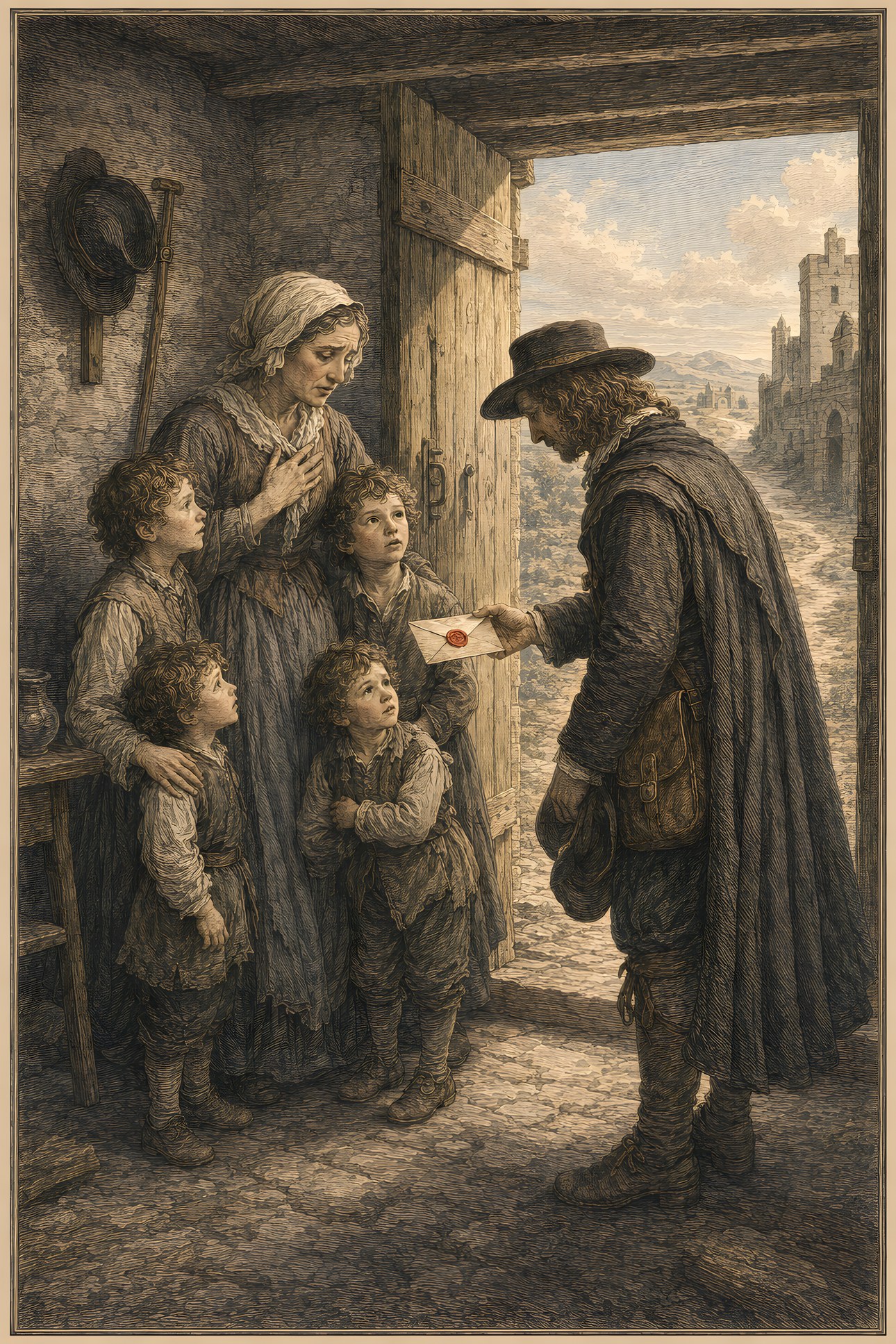
Next morning, when she was up, had prayed to God, and talked with her children a while, one knocked hard at the door, to whom she spake out, saying, If thou comest in God's name, come in. So he said, Amen, and opened the door, and saluted her with 'Peace be to this house.' The which, when he had done, he said, Christiana, knowest thou wherefore I am come? Then she blushed and trembled, also her heart began to wax warm with desires to know whence he came, and what was his errand to her. So he said unto her, My name is Secret; I dwell with those that are high. It is talked of, where I dwell, as if thou hadst a desire to go thither; also, there is a report, that thou art aware of the evil thou hast formerly done to thy husband, in hardening of thy heart against his way, and in keeping of these thy babes in their ignorance.